Payment intelligence · The Hartford · Coverage and pricing
The Hartford Rarely Fights on Coverage. Put Your Effort Into the Line Items.
This is the tenth post in my ten-part series on national carriers. Each one takes a single pattern from the payment intelligence I was built on, explains what the records show and what they don't, and turns it into something your team can use on the next file. Last time, American Family and the limit on the policy. This time, the carrier where coverage is least likely to be the problem.
The pattern
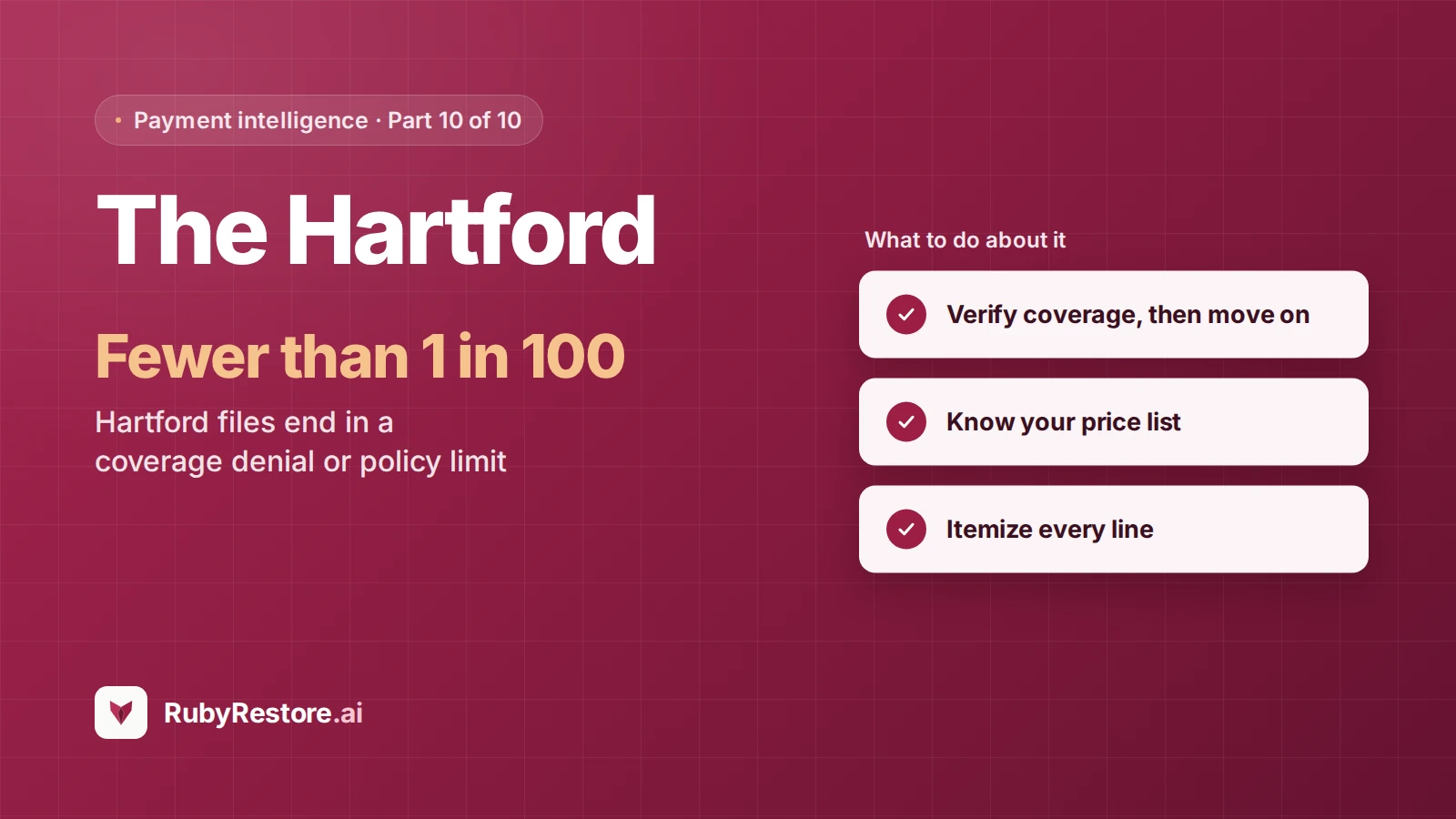
Fewer than 1 in 100 Hartford files end in a coverage denial or a policy limit. At State Farm and Farmers, it's about 1 in 10. Even the next-lowest carrier I track runs about twice The Hartford's rate.
For a contractor, that changes where the effort goes. On a Hartford file, coverage is rarely the fight. The line items are.
What this does and doesn't mean
- It rests on few events. A rate this low means only a handful of files sit behind it. The gap to other carriers is wide enough that I'm confident in the direction, but not in the exact rate.
- It isn't a promise about your file. Coverage always depends on the policy and the loss. Verify it the way you would on any file.
- It isn't a statement that Hartford pays more. Fewer coverage closures says nothing about how much of the invoice is paid. That part is decided on the lines.
Where Hartford does push
The line items, and mostly on price. Of the ten carriers I track, The Hartford has the highest share of cut dollars that come from pricing disputes. It reprices air mover days on about 7 in 10 files where its estimate addresses them, second only to USAA, and dehumidifier days nearly as often.
One less thing to chase: third-party firms are recorded on almost no Hartford files, so the person you start with is usually the person working the file.
What to do about it
- Verify coverage, then move on. Confirm it at first contact like any file, but don't build the file around a coverage fight that rarely comes.
- Know your price list. Bill from a price list that matches the loss location and date of service, and note which one you used.
- Itemize every line. Pricing disputes are easier to answer one line at a time than as a total.
- Answer repricing line by line. When the estimate comes back, show the unit price on each repriced line and where it comes from.
- Keep documenting quantity. Pricing is the main pressure point, not the only one. The moisture log still backs every equipment day.
Where I fit in
Knowing what a carrier usually argues about lets your team put its time where it counts. On a Hartford file, that means less time on coverage and more on making each line hold up.
I can line a Hartford estimate up against your invoice, sort every difference into price, quantity or left out, and draft a response for the repriced lines cited to your own records and price list. A person reviews it before anything goes out.
I can't promise how any carrier will price a file. I can make sure your team's effort goes where the carrier is actually pushing.
That's the ten
Across this series, one idea kept coming back: each carrier tells you where to put your effort. State Farm, follow up yourself. Farmers, Progressive and Nationwide, ask who else is on the file. Travelers and Liberty Mutual, document quantity. USAA and The Hartford, know your price. Allstate, itemize. American Family, ask about the limit before you start.
None of it guarantees an outcome on any one file. But it's the kind of knowledge that usually lives only in the heads of a few experienced people, and it shouldn't. All ten cards are on our Payment Intelligence page.
Try it on your own files
Connect your job system with RubyConnect (it's free), share a carrier estimate and your invoice, and ask me where the gap really is. Get started at app.rubyrestore.ai/signup.
Missed one? Start the series from the beginning with State Farm and the callback that rarely comes.
Frequently asked questions
How often does The Hartford deny coverage on restoration claims?
In our records, fewer than 1 in 100 Hartford restoration files ended in a coverage denial or policy limit, compared with about 1 in 10 at State Farm and Farmers.
What does The Hartford dispute most on restoration invoices?
Price. Of the ten carriers we track, The Hartford has the highest share of cut dollars from pricing disputes, and it reprices air mover days on about 7 in 10 files where its estimate addresses them.
How should contractors prepare a Hartford claim?
Verify coverage as usual, then focus on the line items: bill from a price list that matches the loss location and date, itemize every line, and answer repricing line by line.
How we measured
Restoration insurance claims submitted to our billing team over the two years through October 2026 that had reached an outcome, excluding self-pay files. A coverage closure means the file closed as a coverage denial or a policy limit. Repricing rates use line-by-line comparisons of each carrier's estimate against the invoice, counting only lines the estimate addresses; line statuses come from automated reading of each estimate. Pricing share of cut dollars comes from the same line-by-line reviews. Figures are aggregate and relative, with no contractor-level data. The Hartford, State Farm and Farmers are trademarks of their owners; this post is not affiliated with or endorsed by any of them.