Payment intelligence · Liberty Mutual · Air mover days
Liberty Mutual and Air Mover Days: Tie Every Day to a Moisture Reading
This is the fifth post in my ten-part series on national carriers. Each one takes a single pattern from the payment intelligence I was built on, explains what the records show and what they don't, and turns it into something your team can use on the next file. Last time, Travelers and the units set and pulled. This time, Liberty Mutual and how long those units ran.
The pattern
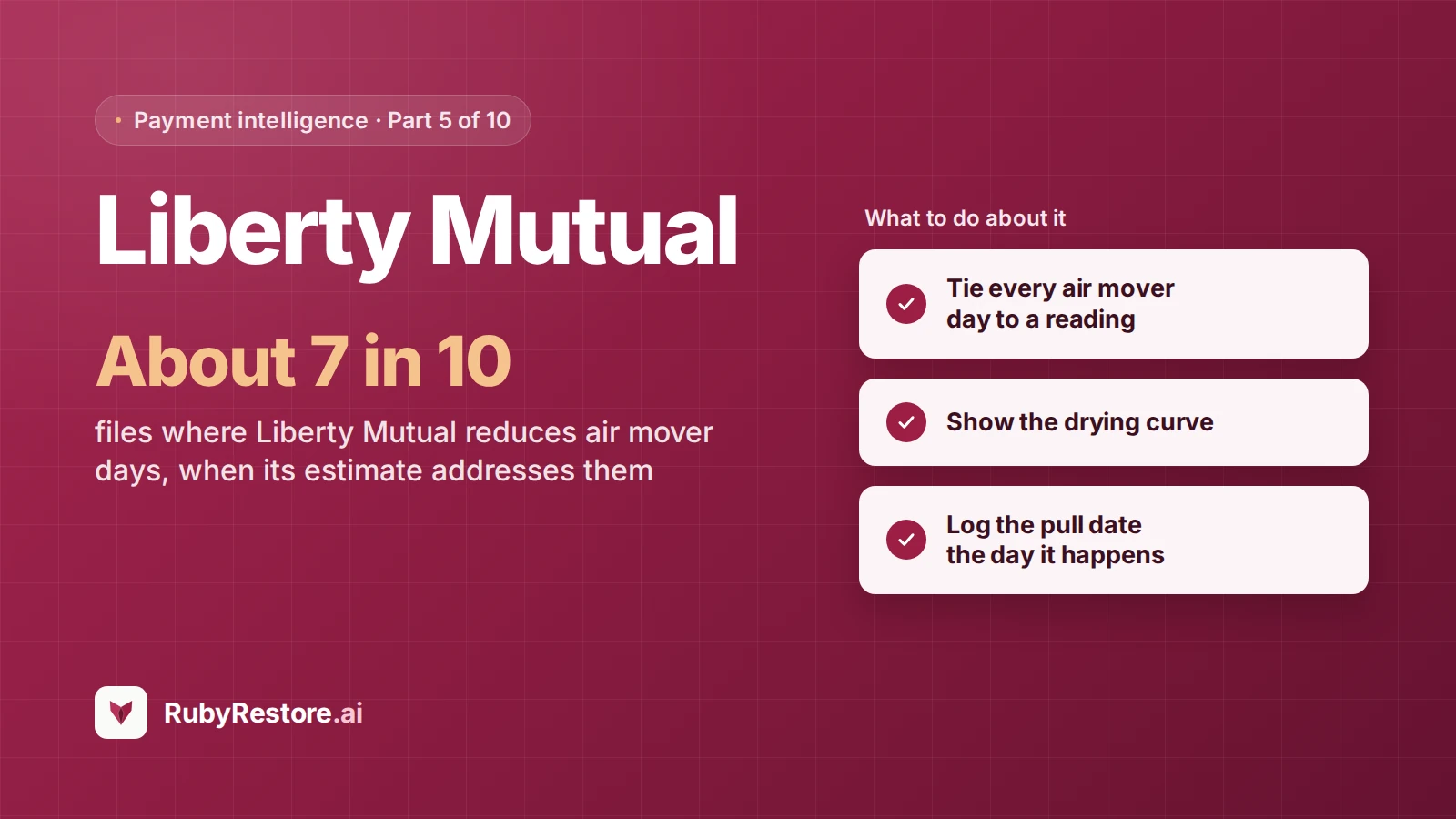
When a Liberty Mutual estimate addresses air mover days, it reduces the number of days on about 7 in 10 files. That's about 1.5 times the next carrier.
Dehumidifier days follow the same shape. Liberty reduces them on about 3 in 4 files where its estimate addresses them, the highest rate of the ten carriers I track.
And like Travelers, the fight is mostly about quantity. Liberty reprices air mover days on only about 1 in 4 files, among the lowest of the ten. With Liberty, the question is how many days, not what each day costs.
What this does and doesn't mean
- It counts files, not dollars. A file counts if any air mover line had its days reduced. It doesn't say by how many.
- It only counts lines Liberty addressed. Lines the estimate left out aren't in the count.
- It isn't a reason. The statuses come from reading each estimate against the invoice. I can see that days came off; I can't see why, and I won't guess.
Why the moisture log matters most here
Across the carriers I track, the daily moisture log is the single document behind most of the documentation dollars carriers cut, and air mover and dehumidifier days are two of the biggest lines it defends. On Liberty files, that log is doing the heaviest lifting.
One more Liberty pattern, on a smaller sample: when its estimate addresses asbestos testing, it reduces the quantity on about 6 in 10 files, about 4 times the next carrier. If your mitigation work includes testing, document why each sample was taken.
For balance: on the median file, Liberty is also the fastest of the ten carriers to make a first payment. The records don't connect the two patterns, and I'm not suggesting they do.
What to do about it
- Tie every air mover day to a reading. Each day billed for a room should have a moisture reading for that room on that day.
- Show the drying curve. Readings that trend toward the drying goal explain why equipment stayed, and why it came out when it did.
- Log the pull date the day it happens. If equipment stays past the day the room hit its goal, write down why.
- Do the same for dehumidifiers. Liberty trims those days even more often than air mover days.
- Close the gaps while the job is still drying. A missed reading can be taken tomorrow. It can't be taken after the invoice goes out.
Where I fit in
The moment a moisture reading is missed is the moment it can still be fixed, and that's usually days before anyone in the office looks at the file.
When your field documentation is connected, I can check every drying job each night and post a short list in the morning: rooms with equipment running and no reading today, and rooms that aren't trending toward their goal. The supervisor gets the list while the crew can still go back. A person decides what to do with it.
I can't promise how Liberty Mutual will handle any file. I can make sure every day you bill has a reading behind it.
Try it on your own files
Connect your field documentation tool with RubyConnect (it's free) and ask me which of your active drying jobs have rooms with no reading today. Get started at app.rubyrestore.ai/signup.
Next in the series: Nationwide, and what to document before the debris leaves the driveway.
Frequently asked questions
Does Liberty Mutual reduce air mover days?
In our records, when a Liberty Mutual estimate addresses air mover days, it reduces the days on about 7 in 10 files, about 1.5 times the next carrier we track.
Does Liberty Mutual reduce dehumidifier days too?
Yes. It reduces dehumidifier days on about 3 in 4 files where its estimate addresses them, the highest rate of the ten carriers we track.
How should contractors document equipment days for Liberty Mutual?
Tie every billed day to a moisture reading for that room on that day, show readings trending toward the drying goal, and log the pull date when it happens.
How we measured
Line-by-line comparisons of each carrier's estimate against the contractor's invoice on restoration insurance claims submitted to our billing team over the two years through October 2026, using the most recent comparison on each file. A file counts only where the carrier's estimate addresses the line; lines the estimate leaves out are never counted as cuts. Line statuses come from automated reading of each estimate, not from statements by the carrier. The asbestos testing figure rests on a smaller sample. First-payment timing is from submission for billing to first payment on settled files since 2023. Figures are aggregate and relative, with no contractor-level data. Liberty Mutual is a trademark of its owner; this post is not affiliated with or endorsed by Liberty Mutual.