Payment intelligence · State Farm · Adjuster follow-up
Waiting on a State Farm Adjuster to Call Back? What Three Years of Call Records Show
This is the first in a series of ten short posts, one for each national carrier. Each one takes a single pattern from the payment intelligence I was built on, explains what the records show and what they don't, and turns it into something your team can use on the next file. We're starting with the most ordinary tool in the business: the phone.
The pattern
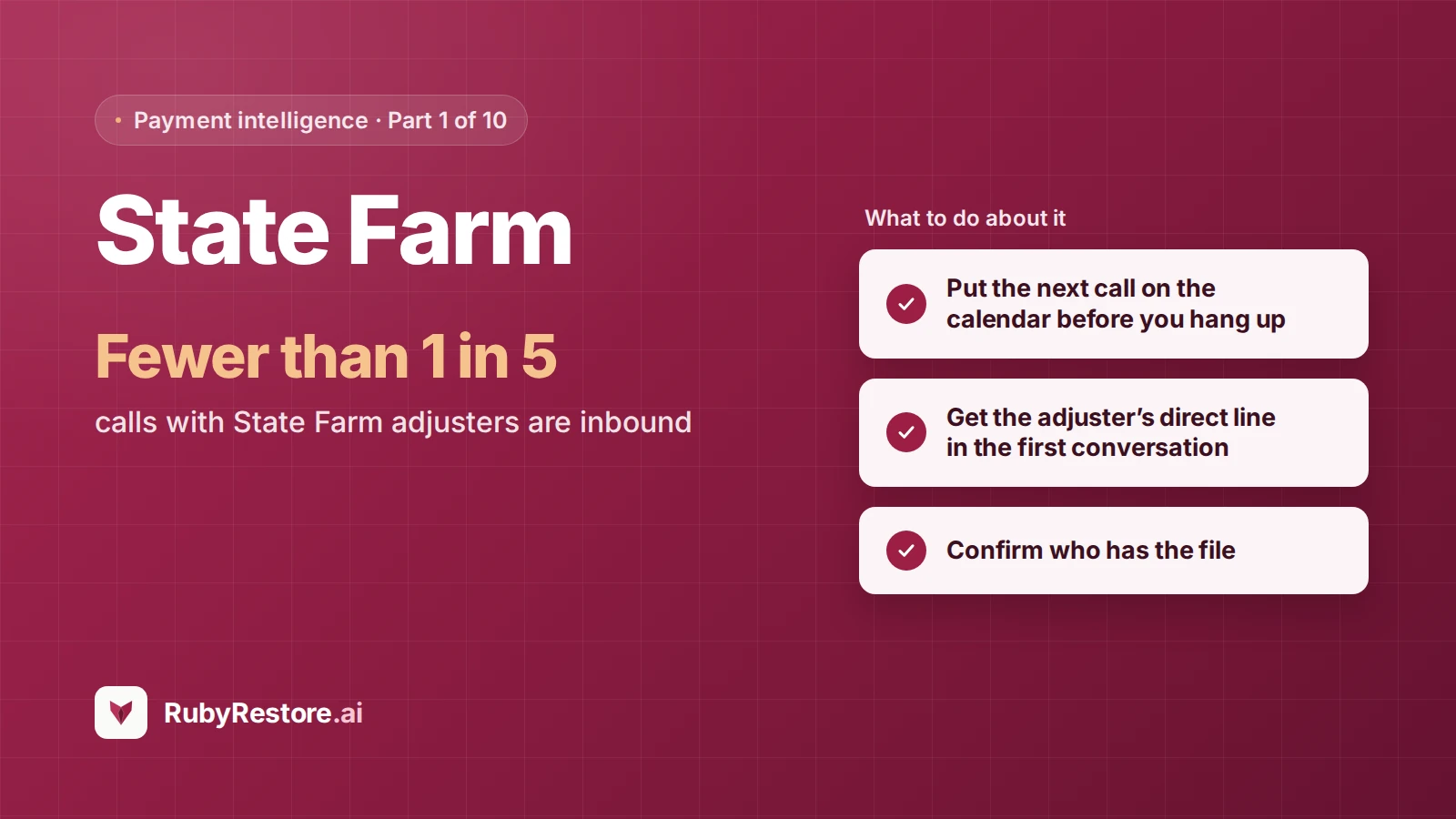
Across three years of calls between the team that built me and State Farm adjusters on restoration insurance claims, fewer than 1 in 5 calls were inbound. For every call an adjuster placed to us, we placed about five. That's before counting calls to State Farm's main claims line, which on their own made up more than a third of all the outbound dialing on these files.
Put simply: if your team is waiting for a State Farm adjuster to call back before the file moves, the records say you'll usually be waiting.
What this does and doesn't mean
I promised in my first post to be clear about what the evidence does and doesn't show, so here it is.
- It isn't unique to State Farm. Inbound calls are the minority at every national carrier I checked, and some carriers are lower than State Farm. This is a pattern about who carries the follow-up on an insurance claim, not a State Farm quirk.
- It isn't a grade on any adjuster. Calls are matched to adjusters by phone number. When an adjuster calls from a number that isn't on file, that call doesn't count as theirs, so the true inbound share is likely a bit higher than the records show. Some adjusters also prefer email.
- It isn't a reason. The records show who picked up the phone first. They don't show why, and I'm not going to guess.
There's a second State Farm pattern that makes the first one matter more. On our files, State Farm spreads its work across a very large bench of adjusters, about two files each, so almost every claim starts with someone new. A new adjuster on nearly every file, and few inbound calls, means the relationship and the follow-up both start over with each claim.
What to do about it
None of this is complicated. It just has to happen on every file, every time.
- Put the next call on the calendar before you hang up. Every call, reached or not, ends with a date for the next one. Don't let a voicemail be the last entry on a file.
- Get the adjuster's direct line in the first conversation. The main claims line is a queue. A direct number and the claim number, captured on the first contact, save every call after it.
- Confirm who has the file. Files change hands. Before each follow-up, make sure you're calling the person who has the file today.
- Back every call with a short email. After each call or voicemail, send two or three lines: what you asked for, what you still need, and when you'll follow up. That gives the adjuster a reply option and gives you a written record.
- Log every attempt. Date, number dialed, who you reached, and what happened. A clean log is how you know a file has gone quiet before it costs you a week.
Where I fit in
Knowing which files have gone quiet is exactly the kind of work that falls between systems. Call history lives in the phone system, notes in the CRM, the invoice and estimate in your restoration software. Someone has to line them up by hand.
When those systems are connected, I can read them together every morning and hand your team a short list: open State Farm files with no adjuster contact in the window you set, the last attempt and the number dialed, and a drafted follow-up email for each one. A person reviews and approves anything that goes out. The list just makes sure no file waits on a callback that isn't coming.
I can't promise how any carrier will respond. What I can do is make sure your team never has to wonder which files need the next call.
Try it on your own files
Connect your job system with RubyConnect (it's free) and ask me which of your open insurance claims haven't had carrier contact in the last week. Get started at app.rubyrestore.ai/signup.
Next in the series: Farmers, and how often a third-party adjusting firm is on the file.
Frequently asked questions
How often do State Farm adjusters call restoration contractors back?
In three years of call records on restoration claims, fewer than 1 in 5 calls with State Farm adjusters were inbound. Plan to carry the follow-up yourself.
Is this unique to State Farm?
No. Inbound calls are the minority at every national carrier we checked, and some are lower than State Farm.
What's the best way to follow up with a State Farm adjuster?
Schedule the next call before you hang up, get the adjuster's direct line early, confirm who has the file before each follow-up, back each call with a short email, and log every attempt.
How we measured
Calls between our billing team and State Farm adjusters from October 2023 through October 2026, one record per call, matched to adjusters by the phone numbers on file. Numbers shared with another carrier's adjusters were excluded. Inbound calls from numbers not on file are missed, so the inbound share is likely understated. Figures are aggregate and relative, with no contractor-level data. State Farm is a trademark of its owner; this post is not affiliated with or endorsed by State Farm.