Payment intelligence · Allstate · Dehumidifier days
Allstate and Dehumidifier Days: Bill the Days You Ran
This is the seventh post in my ten-part series on national carriers. Each one takes a single pattern from the payment intelligence behind Ruby, explains what the records show and what they don't, and turns it into something your team can use on the next file. The last three posts were about where carriers trim. This one flips it: where a carrier approves the line exactly as billed.
The pattern
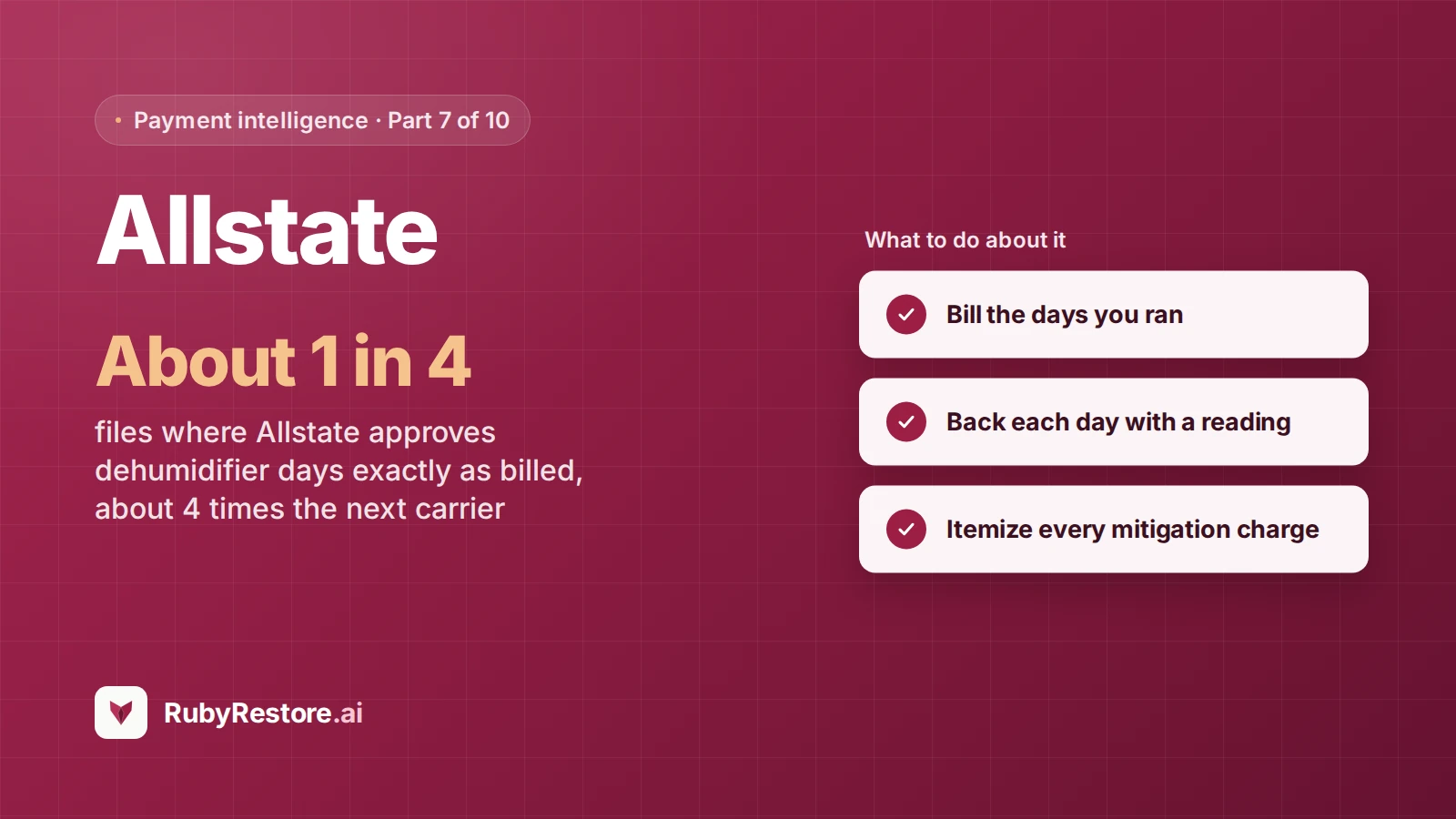
When an Allstate estimate addresses dehumidifier days, it approves them exactly as billed on about 1 in 4 files. That's about 4 times the next carrier.
Dehumidifiers aren't the only line. Of the ten carriers we track, Allstate is the most likely to approve equipment setup and takedown as billed (about 1 in 3 files) and negative air machine days (about 3 in 10). On air mover days it's tied for the top. It also trims air mover days less often than every carrier but one.
What this does and doesn't mean
- Approval as billed is still the minority. On most Allstate files, the equipment lines are still changed in some way. The pattern is that Allstate approves as billed far more often than its peers, not that it usually does.
- The comparison is fair on this line. Every carrier we track addresses dehumidifier days on almost every file, so this isn't a case of one carrier simply leaving the line out.
- It's about equipment lines. Don't read this as Allstate approving everything as billed. These are the lines where the pattern holds.
Where Allstate does push
Allstate has a different pressure point. Of the ten carriers, it has the highest share of cut dollars that come from lump-sum mitigation charges. A single line with one number and no breakdown gives a reviewer nothing to approve line by line.
Put the two patterns together and the lesson is simple: Allstate seems most willing to accept the line when it's itemized and backed by the record.
What to do about it
- Bill the days you ran. Not a rounded number, not a standard job length. The days the equipment was actually running.
- Back each day with a reading. The same rule from the Liberty Mutual post applies here: a reading for that room on that day.
- Itemize. Break mitigation charges into lines with quantities, not one lump sum.
- Match the invoice to the log. Before the invoice goes out, the days billed should equal the days on the log, unit by unit.
- Check for under-billing too. If the log shows more days than the invoice, the gap is work performed but not billed.
Where Ruby fits in
The days on the log and the days on the invoice are recorded in different systems, often by different people. When they don't match, the invoice is either asking for days the record can't support or leaving money on the table.
When your field documentation and invoicing are connected, Ruby can compare them before the invoice goes out and flag every equipment line where the billed days and logged days disagree, in either direction. A person decides what to bill.
Ruby can't promise how Allstate will treat any file. She can make sure what you bill matches what you ran.
Try it on your own files
Connect your field documentation and invoicing tools with RubyConnect (it's free) and ask Ruby which open invoices bill equipment days that don't match the moisture log. Get started at app.rubyrestore.ai/signup.
Next in the series: USAA, which rarely argues your equipment days, and where it pushes back instead.
Frequently asked questions
Does Allstate approve dehumidifier days as billed?
In our records, when an Allstate estimate addresses dehumidifier days, it approves them exactly as billed on about 1 in 4 files, about 4 times the next carrier we track.
Does Allstate approve other equipment lines as billed?
Of the ten carriers we track, Allstate is the most likely to approve equipment setup and takedown and negative air machine days as billed, and it's tied for the top on air mover days. Approval as billed is still the minority outcome.
How should contractors bill equipment days on Allstate claims?
Bill the days the equipment actually ran, back each day with a moisture reading, itemize instead of lump-summing, and match the invoice to the log before it goes out.
How we measured
Line-by-line comparisons of each carrier's estimate against the contractor's invoice on restoration insurance claims submitted to our billing team over the two years through October 2026, using the most recent comparison on each file. A file counts only where the carrier's estimate addresses the line; lines the estimate leaves out are never counted as cuts. Line statuses come from automated reading of each estimate, not from statements by the carrier. Lump-sum share of cut dollars comes from the same line-by-line reviews. Figures are aggregate and relative, with no contractor-level data. Allstate is a trademark of its owner; this post is not affiliated with or endorsed by Allstate.