Payment intelligence · USAA · Equipment pricing
USAA Rarely Argues Your Equipment Days. Expect the Pushback on Price.
This is the eighth post in my ten-part series on national carriers. Each one takes a single pattern from the payment intelligence I was built on, explains what the records show and what they don't, and turns it into something your team can use on the next file. Travelers and Liberty Mutual argue about how many. USAA is the mirror image.
The pattern
On the three biggest drying equipment lines (air movers, dehumidifiers and negative air machines), USAA trims the day count less often than any other carrier I track. On the same three lines, it reprices more often than any other carrier.
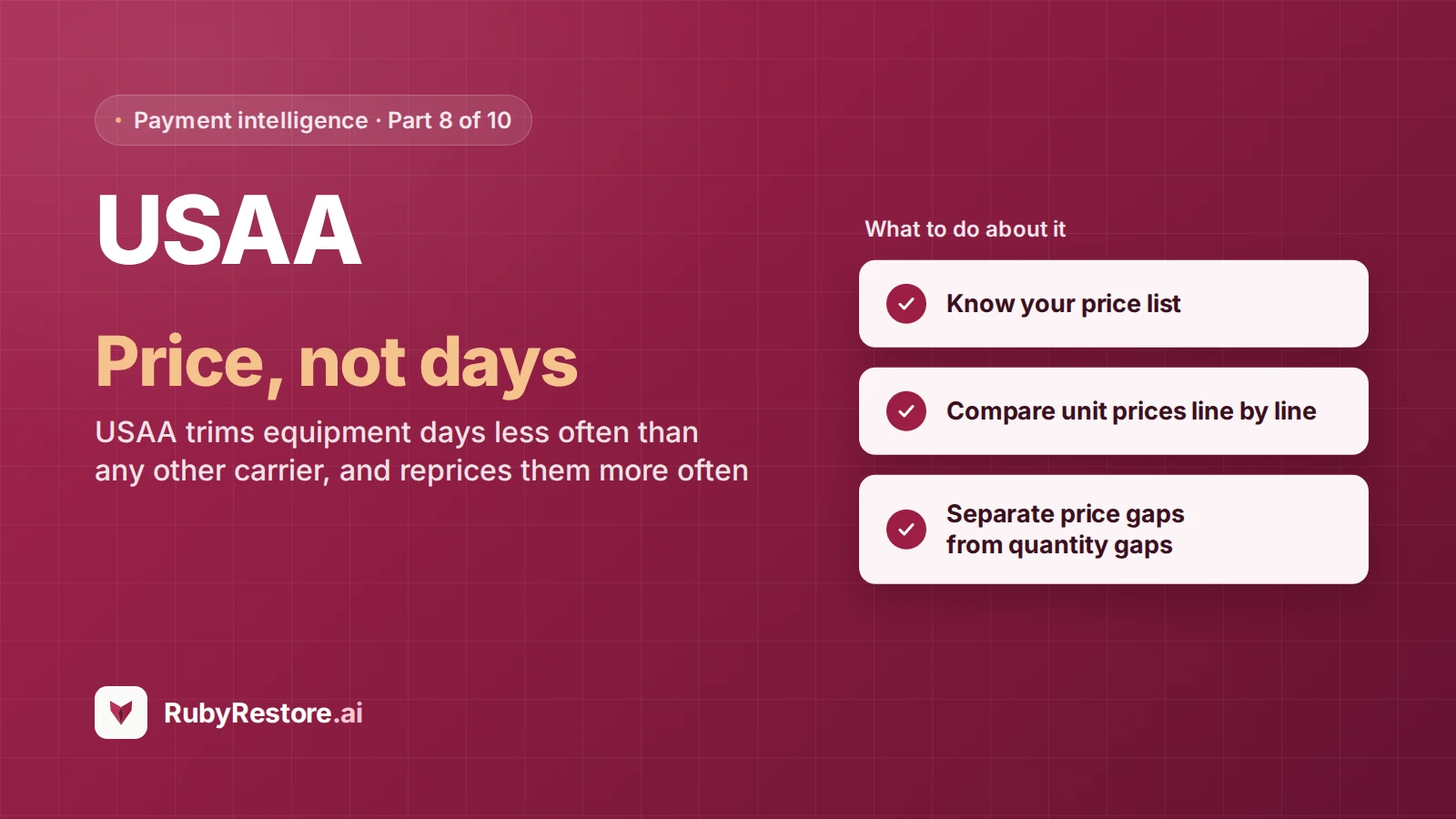
On air mover days, for example, USAA trims the days on about 1 in 5 files where its estimate addresses them, but reprices them on about 3 in 4. With USAA, the pushback is mostly about price, not days.
What this does and doesn't mean
- The gaps are narrow. USAA is lowest on days trimmed and highest on repricing on all three lines, which is why I trust the pattern. But the next carrier is close each time, so I'm not putting a multiple on it.
- Repricing doesn't say by how much. A repriced line may be a few cents a unit or much more. This counts how often, not how big.
- Days still matter. About 1 in 5 to 1 in 3 files still have days trimmed on these lines. Lowest isn't zero.
Where price comes from
Repricing usually comes down to which price list and which date the estimate uses compared with the invoice. When those differ, every unit on the line can shift even when the day count is accepted in full.
One more thing to know: on about 1 in 6 recent USAA files, Wardlaw, the third-party firm from the Farmers post, is also recorded. Ask on the first call.
What to do about it
- Know your price list. Bill from a price list that matches the loss location and the date of service, and note which one you used on the invoice.
- Compare unit prices line by line. When a USAA estimate comes back, check each repriced line's unit price, price list and date against yours before you respond.
- Separate price gaps from quantity gaps. They need different answers. A pricing response that also argues accepted days muddies the file.
- Keep documenting days anyway. Days are trimmed less often, not never. The moisture log still protects you.
- Answer specifically. A short response that shows the right unit price for each repriced line is easier to review than a general objection to the total.
Where I fit in
When an estimate comes back short, the first job is figuring out what kind of short it is. Lining up a carrier estimate against an invoice by hand, line by line, is slow work that most teams don't have time to do on every file.
I can line the estimate up against your invoice and sort every difference into price, quantity, or left out. For a USAA file, that usually means a short list of repriced lines with the unit price on each side. From there I can draft a response cited to your own records. A person reviews it before anything goes out.
I can't promise how USAA will price any file. I can show your team exactly where the gap is.
Try it on your own files
Connect your job system with RubyConnect (it's free), share a carrier estimate and your invoice, and ask me to split the difference into price, quantity, and lines left out. Get started at app.rubyrestore.ai/signup.
Next in the series: American Family, and what its policy limits usually turn out to be.
Frequently asked questions
Does USAA reduce equipment days on water mitigation invoices?
Less often than any other carrier we track. On air movers, dehumidifiers and negative air machines, USAA trims the day count least often of the ten carriers, though the next carrier is close.
Does USAA reprice equipment lines?
Yes, more often than any other carrier we track. On air mover days, it reprices the line on about 3 in 4 files where its estimate addresses it.
How should contractors respond to USAA repricing?
Check each repriced line's unit price, price list and date against your invoice, separate price gaps from quantity gaps, and answer each repriced line specifically.
How we measured
Line-by-line comparisons of each carrier's estimate against the contractor's invoice on restoration insurance claims submitted to our billing team over the two years through October 2026, using the most recent comparison on each file. A file counts only where the carrier's estimate addresses the line; lines the estimate leaves out are never counted as cuts. Line statuses come from automated reading of each estimate, not from statements by the carrier. Third-party firms are as recorded on each file. Figures are aggregate and relative, with no contractor-level data. USAA and Wardlaw are trademarks of their owners; this post is not affiliated with or endorsed by either of them.